Grabovoi Technologies and the Extension of Biological Lifespan: Evidence from a Tomato Experiment
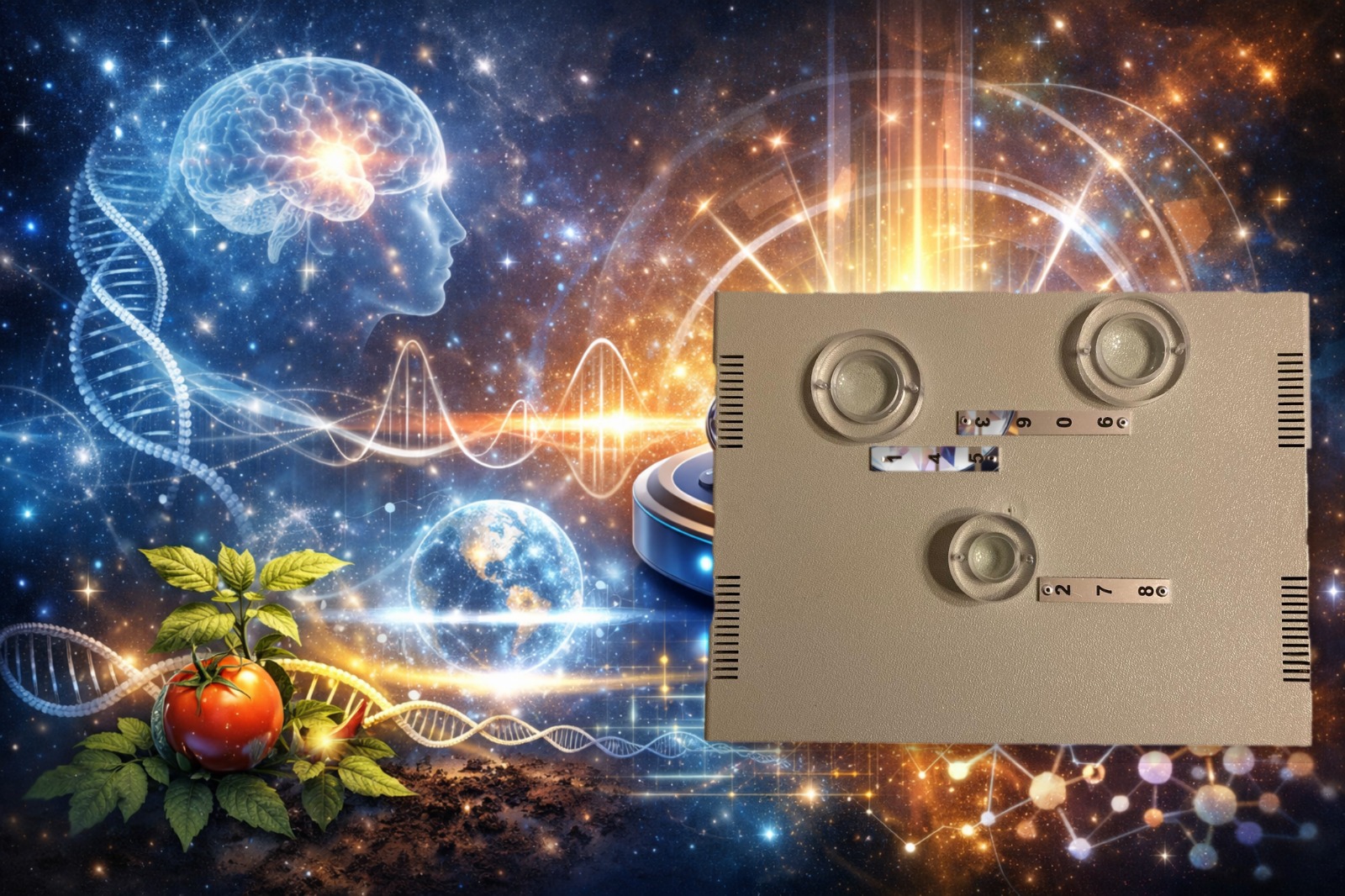
An experimental observation on a tomato suggests anomalous biological preservation near Grabovoi PRK devices, opening new perspectives on information-based approaches to biological lifespan extension.
Introduction
Among the various technologies proposed by Grigori Grabovoi, the PRK-1U, PRK-1UM, and PRK-1UG technologies occupy a central position. They are presented as optical–informational devices capable of interacting with the biosignals of human consciousness. On these theoretical foundations, a body of technical literature has developed in recent years, consisting of patents, scientific–practical reports, and explanatory documents describing the functioning of these devices and their possible applications to health and catastrophe prevention.
In the first part of this article, I outline the logic of the three PRK devices as it emerges from Grabovoi’s literature and related documents. In the second part, I describe in detail a practical experiment conducted using a tomato, which shows a significant anomaly in the preservation of plant tissue in proximity to the PRK-1U. Starting from this case, I open a discussion with the concepts of low temperature, hibernation, and cryopreservation. Finally, I present an already initiated scientific research project at the Nikola Tesla Popular University (UniTesla), where these phenomena will be studied in a more structured way together with other experiments related to Grabovoi’s technologies.
1. The Three PRK Devices in Grabovoi’s Literature
The PRK-1U is described in patents and technical documentation. Its technological basis, according to Grabovoi’s texts and patents registered in his name (for example RU2148845C1 and RU2163419C1), is founded on:
- an optical system composed of lenses and crystalline elements;
- a sensory block capable of detecting the operator’s biosignal (biosignals, emission of thoughts, weak electromagnetic components);
- a physical–mathematical model that treats thought as an informational signal or wave function, with references to concepts from quantum mechanics and electrodynamics.
The PRK-1U is presented as a self-regulating, individually designed device: the arrangement of the lenses, calculated using numerical methods (for example integrals solved via the Runge–Kutta method), is different for each unit in order to optimize interaction with the operator’s signals.
From Grabovoi’s perspective, the device does not “heal” by itself, but amplifies and orders the informational light of consciousness. The systematic use of the PRK-1U is described as a tool to harmonize events, improve health, and stabilize reality within what he calls the Creator’s Norm.
1.2 PRK-1UM: Three Modes and Scientific–Practical Basis
The PRK-1UM is an evolved version, also featuring three operational modes. In the scientific–practical reports available on Grabovoi’s official websites, references are made to:
- studies on biophotons and neurophoton emissions of the human brain;
- electromagnetic phenomena associated with mental activity;
- patents describing information transmission systems based on the emission of thoughts.
The PRK-1UM is thus positioned at the crossroads of:
- nonlinear optics,
- Grabovoi’s unified theory of consciousness,
- biophysics of biosignals.
According to this literature, consciousness is a regulatory informational structure connected to the Pure Informational Field (a concept partially comparable to the morphogenetic field or akasha used in other contexts). The device acts as a structured bridge between consciousness and reality.
The PRK-1UG is presented as a further evolutionary step. In the related divulgative and technical materials, its action is described in terms of:
- interaction of mental emission with laser radiation inside the device, functioning as an optical resonator;
- connections with gravitational waves and cosmic microwave background radiation;
- the presence of internal crystalline chains (“luminous” chains) that refract light in many directions, generating a field structure associated with what Grabovoi calls the “matter of eternity.”
2. A Tomato Experiment: An Anomaly in Biological Preservation
2.1 Experimental Design
To verify in a simple and concrete way whether the presence of the PRK-1U device could have a measurable influence on a biological system, I conducted a comparative experiment using an easily observable plant organism: a tomato.
The protocol, in its initial form, was as follows.
Sample selection
- Two tomatoes with the same degree of ripeness, visually selected to be comparable in consistency, color, and absence of apparent lesions.
Environmental conditions
- Both placed in an environment with the same temperature and humidity (same building), without artificial refrigeration or active temperature control: ordinary room-temperature conditions.
Group assignment
- Tomato A (experimental): placed a few centimeters from the PRK-1U device, within the declared range of action.
- Tomato B (control): placed at a distance greater than the declared range of action of the device, in the same building but in a different room, serving as an environmental control.
The aim was to observe visually, and where possible through weighing, the evolution over time: appearance of mold, loss of firmness, weight variation, and any odors of degradation.
2.2 Temporal Observations
Around day 15
- The control tomato (B) clearly showed visible mold, marked softening, and tissue degradation, consistent with what is expected for a tomato kept at room temperature for two weeks.
- The tomato near the PRK-1U (A) appeared intact, with no visible surface mold and substantially preserved firmness.
After more than two months
- Tomato A was still intact and apparently healthy, with the only difference being a 25–30% loss of weight, attributable to water loss through evaporation.
- Tomato B was completely degraded, with collapsed tissues and advanced mold.
To assess the plausibility of the event, I consulted an agronomist, who confirmed that such prolonged preservation of tomato A is anomalous under the described conditions and not explainable by ordinary mechanisms known for a fruit of this type kept at room temperature.
This remains a preliminary experiment, with a single sample per group; however, the difference between the two degradation trajectories was sufficiently marked to justify more structured investigations.
2.3 Connection with Low Temperature and Hibernation
In plant physiology it is well known that:
- low temperatures slow cellular metabolism and therefore degradation and microbial growth;
- refrigeration extends the preservation of fruits and vegetables;
- cryopreservation, at temperatures far below 0 °C, can almost completely halt degradation by freezing intracellular water.
To obtain, at room temperature, a preservation effect as prolonged as that observed in tomato A, one would normally need:
- highly specific environmental conditions (controlled atmosphere, minimal microbial load, specific lighting);
- or an influence on the immediate microenvironment of the fruit, such as electromagnetic fields or specific light bands.
In this context, a device capable, under reproducible and verifiable conditions, of:
- significantly slowing biological degradation of living tissue;
- prolonging structural stability at room temperature;
would constitute a scientific revolution, introducing the idea that information and optical–gravitational fields may play a role comparable to temperature in controlling biological stability.
The tomato experiment is not definitive proof, but it is a concrete experimental signal that makes systematic research reasonable.
3. Toward Structured Scientific Verification:
The Role of the Nikola Tesla Popular University
The coherence between the empirical observation and the theoretical descriptions of the PRK devices led me to propose a further step: transforming these observations into a formalized experimental protocol, assessable according to shared scientific criteria.
3.1 Experimental Proposal and Acceptance by UniTesla
I presented to the Nikola Tesla Popular University a structured proposal including:
- systematic replication of the tomato experiment with adequate sample sizes;
- PRK-1U powered-on and powered-off groups;
- placebo objects of similar shape;
- environmental controls for temperature and humidity;
- quantitative assessment of degradation.
Additional experiments will involve other fruits, seeds, plants, water, crystallization processes, and, where possible, biophoton measurements.
UniTesla has accepted the proposal, recognizing its scientific and ethical interest.
Conclusions
The PRK technologies propose a radical vision: that consciousness, supported by optical–informational devices, may influence the stability of living matter.
The tomato experiment provided a concrete indication of anomalous preservation under apparently identical conditions. While preliminary, this observation opens a path toward structured scientific investigation.
If confirmed under controlled and reproducible conditions, these results may represent not merely a scientific curiosity, but a new frontier in the understanding of life, time, and the evolution of human consciousness.
Author’s Note
The opinions and interpretations expressed in this article are solely those of the author. Information about the devices and related content has been extracted and reworked from the official websites of Grigori Grabovoi.