3I/ATLAS and the Solstice: When an Interstellar Comet Seems to Point Toward the Heart of the Galaxy
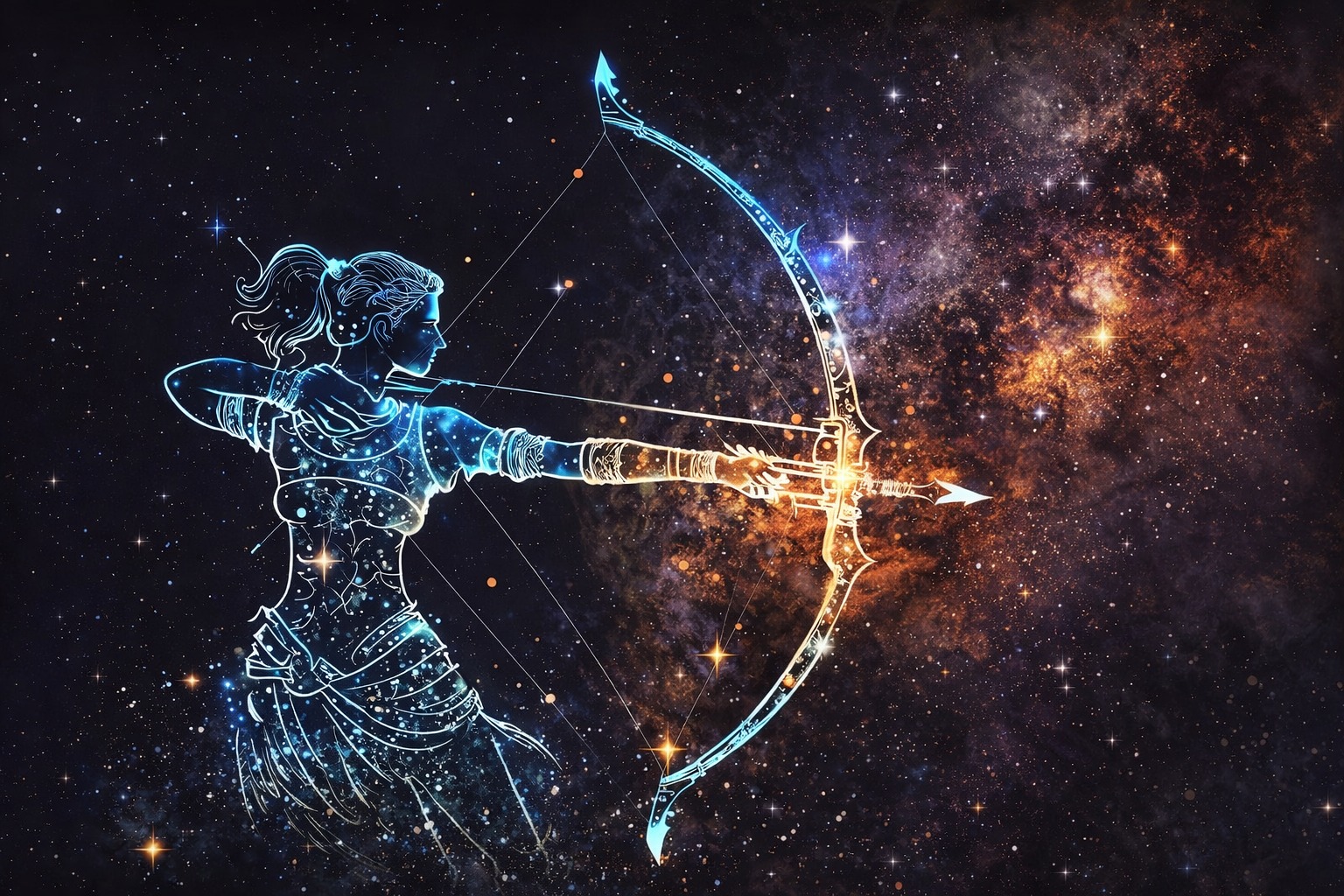
A rare astronomical coincidence links the passage of the interstellar comet 3I/ATLAS with the seasonal alignment of Earth, Sun, and the Galactic Center. A narrative blend of science and symbolism inspired by the direction of Sagittarius.
In the winter of 2025, the sky offers a rare, quiet, and fascinating coincidence.
The interstellar comet 3I/ATLAS, the third known object to enter our Solar System from beyond its boundaries, will reach its closest approach to Earth on December 19.
An extraordinary event on its own, made even more intriguing when viewed within the broader astronomical context of those days.
A visitor arriving from the region of Sagittarius
NASA analyses indicate that 3I/ATLAS enters the Solar System from a wide region of the sky associated with the constellation Sagittarius.
This is the same sector of the heavens where, from Earth’s vantage point, we see the center of the Milky Way — a region crowded with stars, interstellar clouds, and energetic phenomena.
It is essential to clarify: this does not mean the comet comes from the Galactic Center itself.
Its arrival direction is only a projected position on the celestial sphere.
The scientific fact is simple.
The suggestion, however, arises naturally.
December 19: the comet reaches its closest point to Earth
On December 19, 2025, 3I/ATLAS will reach its minimum distance from our planet.
A safe passage, yet close enough to spark both scientific interest and public curiosity.
And this is where a second coincidence begins to take shape.
Earth looks toward the center of the galaxy
Two days later, on December 21, the winter solstice will occur.
During this period, due to a simple geometric effect of Earth’s orbit:
👉 Earth, the Sun, and the Galactic Center reach their best annual approximation of alignment.
It is a regular phenomenon tied to the Sun’s apparent motion along the ecliptic,
and it marks the moment when Earth — geometrically speaking — looks directly toward the heart of our galaxy.
The alignment window: December 18–23
Astronomers often consider not a single day, but an alignment window, since the Sun shifts roughly one degree per day across the sky.
For 2025, the useful window for the Earth–Sun–Galactic Center alignment can be placed between December 18 and December 23.
Within this interval:
- December 21 marks the peak alignment;
- but December 19, the day 3I/ATLAS makes its closest pass,
falls squarely within the same geometric window.
During these days:
- the Sun points almost exactly toward the Galactic Center,
- Earth occupies nearly the same orbital position each day,
- the angular difference is reduced to just a few degrees,
- the alignment is already fully underway.
Scientific Note
The “alignment window” is a simplified, non-technical expression used in outreach to describe the period during which the Sun’s apparent position is closest to the direction of the Galactic Center. It is not an official astronomical term but helps illustrate the geometry involved.
Against this astronomical backdrop, the narrative begins to unfold.
The coincidence that links the two events
Not because these phenomena are physically connected — they are not.
Not because science suggests a hidden relationship — it does not.
But because the geometry of the sky offers a striking superposition.
🌌 The essence of the metaphor
And so the coincidence grows deeper: the comet seems to invite us not only to look toward the center of the galaxy, but to do so precisely at the moment when Earth, the Sun, and that distant core are nearly aligned. A calling that is not only directional, but temporal: “look now,” while the cosmos draws this rare overlap of perspectives.
A clear metaphor that claims nothing beyond what is observed.
A play of timing and direction: a visitor from Sagittarius arriving at its closest point just as Earth and Sun gaze toward the same region of sky.
An invitation to observe — not interpret
In this celestial synchronicity, the comet seems to suggest not just a place,
but a moment.
A moment when Earth looks toward the center of the galaxy,
and at that very time, an interstellar traveler passes closest to us.
Science reminds us that there is no connection.
The metaphor reminds us that sometimes,
beauty lies not in connection, but in coincidence.
Conclusion
3I/ATLAS is a natural, interstellar object.
The solstice is a recurring geometric event.
The Galactic Center remains one of the most enigmatic places in the cosmos.
Bringing these three elements together does not create new theories —
but it creates an evocative perspective:
a visitor arriving from the same direction Earth gazes toward during the solstice,
at the very moment of its closest approach to our planet.
A symbolic, not scientific, invitation.
A cosmic narrative woven from the way humans have always read the sky.
Cover Image Note
The cover image is an artistic representation of the constellation Sagittarius. It does not depict real astronomical phenomena but symbolizes the direction from which comet 3I/ATLAS appears to arrive, and the area of the sky toward which Earth and Sun are oriented during the solstice. Its purpose is evocative and narrative.